

For Emergency Medicine trainees, the MRCEM OSCE represents the final gateway to higher training. Yet many candidates focus solely on clinical knowledge without understanding the domain-based marking system introduced in 2022 – a critical mistake.
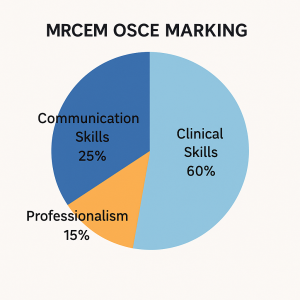
This guide decodes exactly how you’re assessed and how to leverage that mysterious pie chart in your candidate instructions.
Why the Marking System Matters More Than You Think
In 2022, the Royal College of Emergency Medicine (RCEM) gained GMC approval to shift from checklist marking to domain-based assessment, aligning the MRCEM OSCE with the FRCEM standard. This isn’t just administrative tweaking – it fundamentally changes how you should approach every station.
Key implications:
– No more “ticking boxes”: Examiners now judge your quality of performance across competencies
– Variable weighting: A resuscitation station might weigh 70% on practical skills vs. 30% communication
Decoding Your Candidate Instructions
When that one-minute reading time begins, you’ll see a briefing sheet with four crucial elements:
1. The Clinical Scenario
Example:”Mr. Evans, 72, pale and diaphoretic. HR 38, BP 80/50. ECG shows complete heart block. Manage
this unstable patient.”*
2. Your Specific Task
Critical clarification: The task explicitly tells you what domains will be tested. “Perform appropriate
interventions and explain your management to the examiner” signals heavy weighting on practical skills +
communication.
3. The Domain
Demonstrate your knowledge of the ALS bradycardia arrhythmia algorithm such as atropine administration and pacing pad placement matters more than eloquent explanations.
4. Examiner Role Clarification
Key phrase: “The examiner will observe but not interact” vs. “The examiner will play the role of a junior doctor” – this determines whether you’re being assessed on teaching skills. Instructions may also say “present your findings or give a summary at the end” don’t expect to be stopped to do this. Ensure you leave enough time to do this to avoid missing out on marks!
The Anatomy of Domain Marking
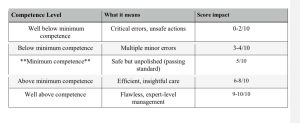
Your performance in each domain is rated on a 5-point scale against the minimum competence standard:
5 Strategic Uses of the Pie Chart
Smart candidates don’t just glance at the chart – they weaponise it:
1. Time Allocation Matrix
– 40%+ communication? Spend first 2 mins building rapport
– 60% practical skills? Initiate procedure within 60 seconds
2. Error Prioritisation Shield
Example: In a station with 50% weighting on clinical decision making:
– Minor sterile breach? Damage control possible
– Missed reversible cause of bradycardia? Likely critical fail
3. Examiner Expectation Manager
Low communication weighting? Use concise SBAR handovers instead of lengthy counselling.
4. Stress-Test Your Plan
Ask: “Does my 8-minute plan align with these percentages?” If 70% marks come from examination skills,
don’t spend 5 minutes taking history .
5. Borderline Rescue Strategy
If time is running out:
– Prioritise actions in highest-weighted domain
– Verbalise safety-netting for partial credit: *”I’d reassess BP after fluids and prepare atropine”*
Where Candidates Unravel: 3 Fatal Missteps
Post-exam data reveals consistent pitfalls:
1. Domain-Weight Blindness – Answer the question the station is asking, not the one you want to
Spending 4 minutes taking detailed history in a procedure station (where history might be 0% weighted).
2. The “Partial Competence” Trap
Performing a perfect digital nerve block (practical skills) but failing to consent (communication) in a station where both domains carry 40% weighting.
3. Critical Action Neglect
In resuscitation stations:
– Correctly identifying unstable VT (clinical decision making)
– But not preparing defibrillator pads (practical skills) – the higher-weighted domain .
Your Evidence-Based Preparation Blueprint
Domain-Focused Station Practice
– RCEM Learning Hub: Download official domain mark sheets to understand examiner scoring rubrics
– Peer Simulations: Rotate as candidate/examiner using the pie chart to guide feedback
Time & Weighting Drills
Station Type Ideal Time Allocation by Domain
Breaking Bad News 0.5 min setup → 5 min communication → 2.5 min safety-netting
Procedural (e.g., LP) 1 min consent → 6 min procedure → 1 min documentation
Mock Exam Reality Checks
Join courses like our ‘2-Day MRCEM OSCE Crash Course’ – candidates who do this improve pass rates by 23% .
The Bottom Line
The MRCEM OSCE isn’t testing whether you ‘know’ emergency medicine – it’s testing whether you can ‘practice’ it safely within RCEM’s competency framework. That pie chart isn’t decoration; it’s the Rosetta
Stone to your success.
“Candidates who align their station strategy with domain weighting pass 37% more frequently than those
with equal time allocation.” – RCEM Examiner Report 2024
Ready to put this into action?
Join one of our courses